Monday, April 28, 2008

Apparently, It Pays to Be Naughty - Vice Fund vs. Socially Responsible Fund


A comparison of Vice Fund vs. Socially Responsible Fund


I heard an anecdote contrasting these funds on Bloomberg on my nifty Sirius Satellite radio and thought I'd check out how the angel on the left shoulder fares against the devil on the right. Yes, there is actually a fund called the Vice Fund, ticker VICEX, that invests in none other than tobacco, casinos, military and alcohol companies. As you may have heard, "socially responsible" investments are all the rage now as well, with the most notable fund being the Neuberger Berman Socially Responsible Investment fund NBSRX.


Interestingly, in the year ago period, the Vice Fund beats both the Socially Responsible Fund AND the S&P500 at 3% up for Vice vs. a loss of 4-5% for the benchmarks.


Next, check out the 5 year view, as the Vice Fund completely trounces both benchmarks at 144% for Vice vs. less than 60% for the benchmarks:


Some notables:


  • Vice Fund gets a 5 star Morningstar rating vs. 4 for Socially Responsible
  • Vice Fund has a higher expense ratio at 1.75% vs. .9%

Vice Fund Top 10 Holdings:


Altria Group Inc. (MO)
9.07%

Carolina Group (CG)
7.15%

MGM Mirage, Inc. (MGM)
5.63%

International Game Tech. (IGT)
5.34%

Diageo PLC ADR (DEO)
5.26%

British American Tobacco PLC ADR (BTI)
4.95%

Boeing Company (BA)
4.81%

InBev (INB)
4.33%

Wynn Resorts, Ltd. (WYNN)
4.13%

Lockheed Martin Corporation (LMT)
3.97%


Socially Responsible Fund Top 10 Holdings:


Comcast Corporation (CMCSK)
4.39%

E.W. Scripps Company (SSP)
4.39%

Anixter International (AXE)
4.13%

Altera Corp. (ALTR)
3.98%

Danaher Corporation (DHR)
3.76%

Willis Group Holdings, Ltd. (WSH)
3.74%

UnitedHealth Group, Inc. (UNH)
3.60%

Bank of New York Mellon Corporation (BK)
3.54%

American Express Company (AXP)
3.32%

BG Grp (BG.)
3.25%


I found the top holding of Comcast in a Socially Responsible Fund to be somewhat ironic, given that they are evil, anti-customer service monopolists (can you tell I have trouble with my cable and internet service?). However, I'm sure they've vetted all their holdings to ensure there are no dealings with the Sudan, profiting from blood diamond trade, etc. In conclusion, let your conscience be your guide at your portfolio's peril.

Sunday, April 27, 2008

Is this 13% Yield Worth the Risk?


I came across a closed end fund today that may make for a nice addition to the self directed IRA account. The Van Kampen Dynamic Credit Opportunities Fund (VTA) is showing a steady monthly yield of $.152 per month, which puts it at a 13% yield given the current $13.77 share price. Although the share price has declined since launch last summer with the rest of the financials, I think it's overdone here since it started accumulating assets once most of the sub-prime carnage was already known and starting to circulate. Given that the dividend has been paid steadily at $.152 every month since launch, and will be in March too, it may be worth buying this one that may be unfairly punished for guilt by association.

VTA doesn't show up on dividend screeners, nor does it even show a percentage yield in Yahoo! Finance, but if you check out the dividend history in "historical prices", "dividends", you'll see the steady history. So, to the question, "Is this 13% Yield Worth the Risk?", I think the answer is a resounding "Yes".

Saturday, April 26, 2008

End-of-Earth Day movies


I've been working today on, well, work and putting together a blog item for tomorrow about Earth Day and taxes. Yes, there are connections.


But a friend and fellow financial journalist/blogger, Dan Ray at CreditCards.com, momentarily distracted me from my nobler cause. He knows I'm a movie nut so he tipped me off to a great feature on End-of-the-Earth Day movies over at Yahoo.


The site, tongue firmly in cheek, notes, "Earth Day is a time to consider the actions you can take to protect the planet. But you shouldn't forget just what it is you're protecting it from."


To that end, Yahoo lists the top 10 causes of world destruction in movies. They are:


10. Giant Falling Rocks as seen in Armageddon & Deep Impact.
; 9. Viral Outbreaks as seen in 28 Days Later, 28 Weeks Later & I Am Legend.
; 8. Satan (and Son) as seen in End of Days & The Omen.
; 7. Nuts With Nukes as seen in Dr. Strangelove.
; 6. The Dead Rising as seen in Night of the Living Dead, Dawn of, Day of & ;Land of the Dead.
; 5. Greenhouse Gasses as seen in Waterworld & The Day After Tomorrow.
; 4. Alien Bureaucracy as seen in The Hitchhiker's Guide to the Galaxy.
; 3. Angry Robots as seen in The Terminator & The Matrix trilogy.
; 2. Angry Monkeys as seen in Planet of the Apes series.


And the number one threat to our beloved planet is,


; 1. Angry Bunnies as seen in Night of the Lepus.


Click on over to Yahoo for more on each of the ways Hollywood thinks we're going to go and, more importantly, what we can do to prevent these cinematic global catastrophes.


Friday, April 25, 2008

Six-Word Memoir Game


I generally don't do blog "tagging" games. Mostly because I could never actually figure out what they actually are. But Twiggers over at In Debt Because I Like to Have Nice Things kindly explained how it worked, and now that I've read a couple posts, it's actually pretty fun to read everyone's lessons learned. Here's my deep and meaningful contribution:

SAVING TOTALLY BORES ME. OH WELL.

LOL! Most other memoirs were super serious so I thought I'd change it up. Seriously, for those of you who are rock stars and love going out, saving will be a challenge. But there are some things you can do to spice it up. Like getting a cheap hobby; I've tried about 500. Knitting? Super cheap but kind of hot for the summer. Step aerobics? Dangerous... I fell off it and hurt myself. Getting a pet to keep you company? So not cheap. Eh... oh well. In the end, I've emerged a stronger, healthier, more content, less chaotic person with a lot to live for and a simple, chill life to enjoy. So call me boring. I do not mind. I'm having fun.

I'm not going to tag because I know it can be laborious sometimes to participate in these things. That said, take a quick read at these memoirs for a nice snapshot of different people in various stages of their financial journeys, and feel free to post your own so-called memoir here. It's actually pretty cool to think about.

IDBILTBNT: "You can't take it with you"
Young Broke and Fabulous: "At least you have the experience"
Beachgirl's Budget Blog: "Do what is best for you"
The Debt Hole: "Falling down. Getting up. Trying again."
Frugalista Files: "Peace, values and a decent wine."

Who else should I add up here???


Evidence that "Namesake" Mutual Funds Outperform their Peers


I came across an academic journal article highlighting the fact that Namesake Funds outperform their peers in several aspects. I thought this was interesting and has some concepts you should keep in mind when selecting an actively managed fund for long term investing in the hopes of exceeding market and peer fund returns. I've condensed 20 pages of research and tables to about a page:


This article summarizes the conflicts that could arise and the ensuing performance when comparing namesake funds to generic funds. A namesake fund is one where the fund manager sites on the board and has significant investments in the fund they manage. The “namesake” is derived from the notion that the fund or the company is generally named after such manager. An example of a namesake fund is the Baron Partners Fund (BPTRX), vs. say, AIM Moderate Growth Fund. The results show that the namesake funds are generally more tax efficient and contain a slightly higher level of unsystematic risk, while outperforming their peers.


Fund managers that are employed by the firm tend to have career concerns, whereas more tenured, famous namesake managers do not share the same concerns. For these reasons, younger managers tend to less risk and follow the crowd, whereas namesake fund managers have fewer career concerns and invest accordingly.


Given these differences, there are five main hypotheses tested for these two populations of fund managers:


1) Namesake funds should have higher fees than generic funds since the namesake fund managers exert more influence on the board and possess a large interest in the company.


2) The namesake funds should be more tax efficient because namesake fund managers typically have a larger portion of their own funds invested.


3) Since namesake fund managers have fewer career concerns, there should be a greater degree of unsystemic risk.


4) Because the namesake fund managers have more at stake with respect to their own funds, it is hypothesized that they should outperform generic funds.


5) Given these benefits and the past, more prestigious roles of the namesake fund managers, it is hypothesized that their funds have higher levels of investor cash flows.

The empirical results provide strong support for these hypotheses:


1) Expense ratios are 12-15 basis points higher for namesake funds than generic funds.


2) Namesake funds do tend to enjoy greater tax favorability than their counterparts. An interesting note here is that since fund managers are generally rated on their pre-tax returns, generic managers are not incented to control the timing or size of tax distributions, whereas namesake managers have more skin in the game.


3) The data also supports the risk assumption. Namesake funds have lower momentum beta, suggesting they do not chase returns as much as their counterparts.


4) Adjusted for all relevant factors, the namesake funds tend to outperform their counterparts by 6-9 basis points per month.


5) The namesake funds do indeed attract more investor cash flows and there is evidence that fund investors are more sensitive to the past performance of namesake funds.

There are some other key characteristics of namesake funds worth considering:


  • The average tenure for namesake fund managers is 6.6 years, which is 1.8 years longer than their counterparts.

  • On average, namesake funds hold 8.4% of assets in cash, whereas generic funds hold 6% in cash.

  • The turnover of namesake funds in the same class is much lower at 50% compared to 81%.


In summary, while I believe excluding some rather unique investment objective you simply can't find anywhere else, you're best investing in index funds, there may be occasions where investors are driven toward actively managed funds. In this scenario, one is well served by first considering a namesake fund over a generic fund given the preponderance of data highlighting the benefits on an aggregate basis.


Source:


Ferris and Yan (2007) “Agency conflicts in delegated portfolio management: Evidence from namesake funds”

Thursday, April 24, 2008

Jewels and Gems


Let's talk jewelry for a minute. A unique shining, shimmering piece can transform a girl. A great necklace can take a look from boring to bravo in seconds. Chandelier earrings, bangle bracelets, diamond studs, fake, real, you name it, I love it... and I probably own it in several styles.

I have a particular weakness for jewelry which started when I was young. As a grade schooler I was enamored by those neon yellow charm necklaces - I even bought a space shuttle charm to wear in honor of the Challenger after it exploded. As a teenager, I spent hours digging in my mom's private jewelry drawer and in her small silver heart-shaped box filled with earrings when she wasn't looking. I started buying my own jewelry in high school, and I amassed a ton of cheap plastic things that looked, well, cheap and plastic. But as an adult my taste has become more sophisticated; I'm always in search of the perfect piece to wear to complement my outfits, and now I have my own jewelry drawer filled with little boxes that I can rifle through when no one's looking.

The problem, of course, is that real jewelry is expensive. A cocktail ring can easily run $50 at Macy's. A heavy steel cuff? Forget about it. Out of my price league.

So how have I created such a great jewelry collection on a budget? Buying jewelry, I've found, is all about creativity and care. I don't buy those expensive trendy pieces that everyone from J. Crew to Banana is showing at their ever-expanding jewelry counters. True budget aficionados do a little more digging... and end up owning a lot more indispensable pieces that they love.

Here are my tips for creating a budget friendly jewelry collection that your friends will envy:

1) Collect family heirlooms. My most beloved piece of all time came from my great aunt's jewelry box. It's a sterling silver cuff that was created in Pennsylvania in the 1960's and looks like one continuous piece of thick silver twisted around my wrist. I get more compliments on it than anything, and I didn't pay a dime for it. I actually don't know how I ended up with the piece, because most of her pricey stuff (and she had a TON of that) was given away or sold after she died. Only her "costume" jewelry remained in a box for Goodwill, which was where I found the silver cuff.

Aside from the obvious benefit of laying claim to free stuff, family jewelry is important to me because it provides a connection to previous generations. The fact that my aunt and I had the same taste, despite the fact that I never really knew her trendy style, is a thought that stays with me. I'm reminded of her every time I wear the bracelet.

2) Search for vintage. I frequent consignment shops and local antique stores for estate jewelry. Sometimes you can get really interesting pieces there, or you can find pieces that are easy to transform. For instance, I bought a really pretty antique silver ring that looks like leaves from a resale shop in a nearby suburb. It was probably $5 because it was missing the main stone. I wore it anyway, and later realized I had the perfect pearl to place in its center. Voila! New vintage jewelry.

3) Make your own, or find someone to do it for you. A friend of mine's mom used to create jewelry from pictures. So if you saw a beaded necklace you liked, she made a replica for you that only cost the price of the stones. There are bead shops that specialize in this sort of thing, like Bead in Hand in Oak Park, Ill. I have a bunch of beads and stones at home that will someday be made into masterpieces when I have time... I just haven't had the chance to do it yet. It's a project for a rainy day.

4) Buy wholesale, and buy local. When I was in Albuquerque, I bought a bunch of turquoise jewelry (earrings, necklace and bracelet) wholesale from a turquoise store. It was ridiculously cheap. I don't know what other kind of gem wholesale stores there are, but that was like finding an oasis in the desert for me. I highly recommend. The other key point her is to buy local. I get lots of cool pieces from open air markets and arts festivals when I travel - the pieces are cheap and they serve as souvenirs. Plus, they always allow me to share a great travel story whenever I wear them.

5) Buy trends cheap. Let's say a few years ago you wanted some big colorful plastic or wooden beads. Where would you go? If you said H&M, you'd be right. If you said any place that would charge you more than $10, you'd be wrong. It makes no sense to spend money on items you'll only wear for one season. I don't do it often, but when I'm buying trends I shop mostly at Target, H&M and Old Navy. Anything more isn't worth it!

6) Ask for moderately priced gifts. My final point is sort of a cheat. I'm usually all about purchasing my own stuff and not depending on anyone to support my lifestyle, but I have found that asking for moderately-priced jewelry from my parents and boyfriend for my birthday or Christmas typically results in some cool stuff (they ALWAYS ask me to do a list anyway). I love having those items as a special bond between the giver and receiver - made even sweeter when the giver purchases something that perfectly shows he/she gets your style. And I'm not talking gold and diamonds here, any little sparkly thing usually does the trick.

Plus, saving your impulses throughout the year by window shopping to select your next gift suggestion might actually prevent you from making any crazy unaffordable decisions.

I could go on about jewelry but I'd risk sounding super obsessive and TOTALLY boring the males (done and done, I bet). Nah, they're off making their brackets today anyway... this one was for the girls.

Wednesday, April 23, 2008

Taking the big plunge


Today I filled out the paperwork - effective as of my payday at the end of April (since I get paid once a month) I will have about 86% of my salary deducted pre-tax and put into my retirement accounts. I have plenty of money in liquid savings, and will have more by then, so I know logically it will be perfectly fine even if I don't bring in another dime from CashDuck for at least six months, but it's still a little scary to only draw $500 of salary a month! (That is, before my deductions for my insurance premium, gym membership, and FSA.. that's why it's not 100% of my salary.) So I might only bring home $200 a month. I went in to my TIAA-CREF account and put in some allocations for it - I am hoping that the gibberishly named account that doesn't have any money in it is the 457. (All the other gibberishly named accounts have deposits from which I can figure out whether it's my involuntary contributions, voluntary contributions, or the Roth.)

I also signed up with Citi to get the $50 signup bonus (read about it here) but I forgot to put in the code. I was supposed to take out the code that was there, and enter another. Oh well, I can always use more bank accounts. :) I wonder what the original code was supposed to get you.

Tuesday, April 22, 2008

Cluck cluck cluck


That's the sound of the chickens I wish I had. I don't know exactly why, but I'd like to get a couple of chickens. I think it would be cool to be able to go out and get my own eggs, but I'm not sure I could handle the rest of what chicken-ownership might entail. (Such as eating them at some point...)


I like the idea of them out in the yard though, and the idea of living ever-so-slightly more sustainably. (Although I suppose that I'd need a rooster too, to truly make that sustainable in the long run. I don't think my suburban neighbors would tolerate a rooster.)


But then I see things like this fantastic chicken house from a company called Omlet (hah!) and it just makes me want them even more. I mean, how adorable is that chicken coop? Good thing it's in the UK, and I'm not, or there'd probably be a couple of chickens pecking away in the yard right this very minute.


Maybe I'd better stick with my first attempt at gardening for now, and save chickens for a little later. Are you doing anything to try to become more self-sufficient food-wise? If so, what are your reasons for doing so?


Monday, April 21, 2008

Money in the Bank - What are your Best Options for Gaining Interest with your Money


money.jpgCongratulations on making savings a priority!? Now that you have some money in the bank, it is time to figure out what kind of account will yield you the best benefits.? Do not leave your money sitting in checking where it does not accrue interest; this practice does nothing for you, and will not help you grow you money.? In fact, leaving your money in a checking account may actually tempt you to spend more than you intend, so watch out for your funds!


A basic savings account is a better option than your savings account, yielding you a small interest payment each month with little or no minimum balance required in the account.? If you need your money to be highly mobile and available at all times, then this is the perfect account for you, particularly if you tend to maintain a low balance at this point.?


If you have managed to save a few thousand dollars, on the other hand, a money market account might be the best thing for you.? This account has a much higher interest rate than a traditional savings account, but also has a much higher minimum balance, often of several thousand dollars.? If you feel comfortable having a few thousand dollars dedicated to the account at a time, then this might be the perfect option for you.? If you can’t afford not to have instant access to that money, however, you might want to stick to a more traditional savings account.?


If you really don’t mind having your money tied up for a long time, though, you can spend your money on a CD, which stands for Certificate of Deposit.? A CD is a special kind of account, which usually has an even higher rate of return than a money market account, but which ties the full balance up completely.? When you put your money into a CD, you commit the money for a certain amount of time.? You cannot deposit or withdraw to or from that account, and the money that you earn on it is often applied less frequently, sometimes annually.? This kind of account yields higher interest payments, but usually have a large penalty if you withdraw your money before the term is up.? If you can afford to have your money set aside for long periods of time, then a CD might be a good option for long term savings.?


Sunday, April 20, 2008

Taxpayer Bill of Rights approved ... again


Congress' annual political show of support for taxpayers continued yesterday.


Us_capitol_walking_toward_2
Every April 15, lawmakers look to highlight the concerns of John and Jane Public. It's not that I necessarily doubt their sincerity; I'm sure that some in Washington really do want to improve the system and process for us all when it comes to paying for our government's operations.


But I just wish rather than using the tax-filing deadline as a publicity tool, legislators would work on tax issues year round and come up with some changes that actually get implemented.


Take yesterday's latest version of a taxpayer bill of rights. By a vote of 238 to 179, the House approved the Taxpayer Assistance and Simplification Bill of 2008 (HR 5719).


Good job, guys. Now we just have to wait for the Senate to follow suit so the bill can go to the White House for the promised veto.


Despite the doomed prospects, Representatives put on a good front, as well as tried to score some political points in this election year. House Majority Leader Steny Hoyer (D-Md.), pointing to a tax code that has grown by more than 10,000 pages between 2001 to 2006,


said the bill is needed to undo tax code complexity created by the Republican-controlled Congress and the Bush administration.


Against private debt collectors: A key part of the bill, which was introduced by House Ways and Means Oversight Subcommittee Chairman John Lewis (D-Ga.), would prohibit IRS use of third-party debt collectors to bring in unpaid taxes.


Past_due_stamp
Opponents of the debt collectors (notably Lewis, as blogged about here) argue that the private agents are not as efficient as IRS employees
and actually cost more money than they collect. They point to a Government Accountability Office study that found some debt
collectors made unnecessary calls to taxpayers just to meet call volume
goals.


Dubya et al, however, still support the private collection agents, part of the Administration's larger goal of privatizing as many government tasks as they can.


So the debt collector provision alone would prompt the prez to pull out his veto pen.


HSA language problematic, too: However, the White House also opposes a provision in the bill that would require that Health Savings Account (HSA) distributions be verified as used for medical expenses.


Country_doctor_2
Opponents say such reporting requirements for HSA trustees is "unnecessary for efficient tax administration, inconsistent with the flexibility purposely afforded HSAs at their inception and could undermine efforts by employers, individuals and insurers to reduce health care costs and improve health outcomes by empowering consumers to take greater control of health care decision-making."


More on these and other provisions in the latest Taxpayer Assistance and Simplification Bill can be found in this report from WTOP radio and this CNNMoney story.


As for the prospects of legislation to make our taxpaying lives easier, expect lots more posturing leading up to November, but little real action from either side.


California--A Nice Place To Visit But I Wouldn't Want To Live There


Went out to the Bay Area for my niece's wedding. Great trip, had fun, glad to be home given the price of houses and a wee bit of overcrowding. Seems that I am not the only one glad to be out as outlined in this article at MarketMinder.com. Enjoy--if you can.


California Hates the Poor


10/5/2007 |


California hates the poor. At least the Golden State certainly seems to act that way, given the way it treats its lower-income residents.


But wait—isn’t California known as one of the most socially progressive states, spending billions of dollars on social programs and public assistance for low-income residents each year? Indeed! Yet Californian legislators uphold a policy choking off precious dollars that could go to residents needing it most. That wacky policy is the Golden State’s tax structure.


California boasts the most punitive state income tax system in the entire Union. (Not so fast New Jersey, Hawaii, Iowa, and Oregon! Though you’re all nearly as bad.) With so much wealth in the state, you might not feel much immediate sympathy for those paying the lion’s share of the state taxes. After all, California’s got Hollywood movie stars, celebutants, and Dot-Com-mega-billionaires! Make them pay! Folks tend to forget California has millions of souls—the vast majority are Average Joes.


Let’s examine the current tax structure. California income taxes kick in at a modest 1% rate for annual income up to $6,622. Not too bad—$6,622 seems a small amount to hit up for income tax, but 1% isn’t that much. But, California’s highest tax bracket of 9.3% (the highest in the nation) begins at the affluent, wallet-busting, Bentley-driving sum of $43,468.


I’ll repeat that. California imposes the nation’s highest state income tax level of 9.3% on residents earning more than $43,468. Some perspective: In 2004, the US Census reported California’s median income was $51,185—higher than America’s median income of $44,648. Translation: If you’re “middle class,” California wants 9.3% of your income. It’s a shakedown for your lunch money.


Meanwhile, nearby states Washington, Nevada, and Texas charge no state income tax at all. Arizona starts its highest tax bracket at $150,000 where residents pay 4.57%—less than half California’s top rate. It’s hardly surprising these states are some of America’s fastest growing states. In 2006, Arizona’s and Nevada’s populations swelled over 4 times faster than California’s.


If you’re a Californian with a nice retirement savings, where would you retire? California wants a hefty portion of your retirement income every year, whereas nearby Washington and Nevada want none. Add to the equation the far lower cost of living in those states, and relocating seems like a no brainer. So, folks leave and California ends up with none of their income, property, or sales tax revenue.


Those poor souls remaining in California end up with less money to fund public schools, build new roads, pay for social programs and so on. All thanks to politicians ignoring fundamental economic principles and placing too heavy a burden on its working residents and businesses.


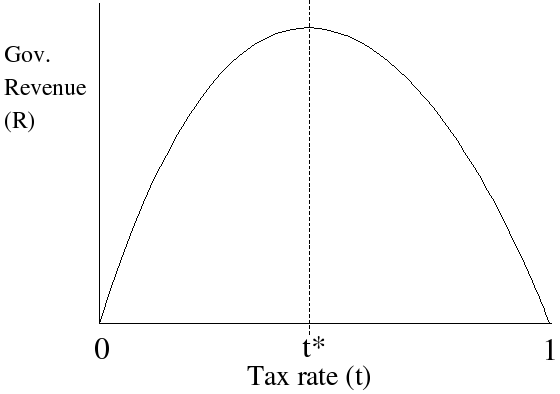
When a state places too heavy a tax burden on its citizens or businesses, the government stifles consumer spending, business investment, and actually ends up collecting far less tax revenue. A government can maximize its tax revenue at an optimal point. Tax too much and folks don’t see much of a reason to get out of bed in the morning. Mrs. Entrepreneur fails to see the upside in launching her cutting-edge new business idea. Less business activity means less tax revenue. The Laffer Curve (shown here http://upload.wikimedia.org/wikipedia/commons/4/47/Laffer_Curve.png) demonstrates the concept.


If prohibitive taxation makes a difference between US states, one could also apply the concept to countries. When a nation imposes high hurdles for new business development and wealth creation, the prospect of strong economic growth becomes increasingly remote. Conversely, if a country slashes corporate tax rates to spur economic activity, all other factors remaining constant, that’s bullish for growth.


Take Ireland for example. The Emerald Isle slashed its corporate tax rate to 12.5%—one of the lowest rates in the developed world.


Selected Corporate Tax Rates by Country


Ireland 12.5%
Netherlands 25.5%
United Kingdom 30.0%
China 33.0%
Belgium 33.9%
France 34.4%
Germany 38.6%
USA 39.5%
Japan 39.5%


Much to the chagrin of France and other EU heavyweights, economic growth in Ireland is soaring! After all, entrepreneurs and existing businesses only need two very simple elements to justify a venture: profit and human capital. Ireland has an educated, English-speaking work force and a corporate tax rate low enough to entice entrepreneurs from around the globe. Ireland will likely attract business activity, people, and tax revenue other countries will miss out on. It shouldn’t be much surprise, then, that Irish GDP growth is expected to more than double the EU’s average. Erin go bragh!


Eastern Bloc countries are also joining the low-tax party. Estonia, Latvia, Russia, Ukraine, Slovakia, Romania, Georgia, and Macedonia all successfully introduced low flat tax structures in recent years. These moves now pressure Western European countries to either become more competitive with their business climates or face a hemorrhaging economic growth towards their neighbors with cheap labor and more welcoming tax structures.


With one of the largest gross domestic products in the world, one could only dream of the economic boom resulting from slashed California tax rates (not to mention falling federal tax rates). With the Irelands and Nevadas out there, Uncle Sam and the Golden State better act fast. Their poor depend on it.


Friday, April 18, 2008

A Ridiculous Yielder for the Everyday Finance Self-Directed IRA Portfolio


I had some extra liquid cash from dividends paid in the self-directed IRA account and came across some info on Alesco Financial Inc. (AFN). It's an REIT that has been hammered pretty hard from around 10 a year ago to close to 3 today. Upon the announcement of its quarterly dividend, the stock has started to rebound and I jumped on board. Essentially, given the decline in the share price, the market had priced in a massive cut in the dividend, but that has not been the case.


The dividend had been steady at $0.31 per share for some time and the assumption given the share price decline was that the dividend would be cut substantially or altogether. Fortunately, the dividend has been announced as $0.25 payable April 10 to shareholders of record March 20.
The stock is close to $3, so this represents around a 30% yield. Obviously, this isn't sustainable, so either the share price will rise substantially or the dividend will be cut further to bring the long term yield to something around 10-15%, which is commensurate with the highest yielding sustained price stocks.

I've posted in the past that one has to be skeptical of such high yields, so you need to do your own research on this one. The big driver for me was this recent announcement of the dividend, solidifying management's view of the near term ability to continue to deliver cash back to shareholders.

I took a look at their financials. In the recent quarters, the revenue's been increasing steadily, but cash is declining. Accounts payable has blipped up a bit, but long term debt has declined. There are some offsets you may want to investigate further. In my case, I just threw a few hundred bucks at it, knowing I'm assured at least a dividend payment in the next couple weeks, which of course will buck the stock following ex-dividend, but if this housing/CDO situation turns around and the stock holds on, I could be holding a massive capital gainer with a 30% return on initial investment from dividends along the way.

Thursday, April 17, 2008

Renewing My Season Tickets for the Washington Capitals


Well, at the beginning of the season, I thought these tickets were too expensive and a waste of money. How fast things change after dumping a crappy coach and making some key trades after the All-Star game. (I hope they can re-sign Federov.)


You have to understand something. I am not an NHL hockey fan. I like to watch hockey. I really don’t actually care who is playing. Because I don’t have any friends who play club hockey in DC, I decided to buy some professional league tickets last season and give it a try. It was fun enough that I thought I should buy season tickets for 2007-2008 to have something to do with a boyfriend who likes sports. I actually hate the Southeast Division because I don’t know any of the teams. I grew up in Philly and there is still a small pull at my heartstrings for the Broad Street Bullies. These expansion teams in Florida don’t mean anything to me at all.


When deciding to get tickets, I calculated which seats were the cheapest/best value for me and bought them. I figured out that I could miss 13 games and still come out ahead on the face value of the tickets. I sold off a bunch of games at cost to friends and gave away a bunch as birthday presents and gifts to friends. At $30 a pair, that makes a nice present without being ridiculously generous. I think I only wasted about 4 games worth of tickets out of 41 regular season games and 4 pre-season games.


Of course, by game 35, I was sick of going to The Phone Booth, aka the Verizon Center, and eating their concession food. I sold off the last three games, with some mild regret. My tickets for the last regular season game on Saturday night went to a friend who is a huge San Jose Sharks fan. He misses pro hockey and I was glad to unload the tickets. However, when I found out I could have put them up on Stub Hub for $200 apiece, I was naturally kicking myself. That’s one-third of the price of my season tickets! It was really exciting and I kind of miss not going, but at least my friend is someone who can appreciate what the Caps have done this season.


As a season ticket holder, I have purchased my playoff tickets already. There are privileges to having season tickets. The perks are ok. Special invitation-only events where you can meet the players, etc. I bought 100-level seats for the Penguins-Caps games for a me and a friend who is a Pittsburgh native at a steep discount. I also got 4 100-level seats for free and shared them with another couple that holds season tickets in the 400-level.


I waffled on renewing since I bought the tickets with a boyfriend I am no longer dating. However, I decided to renew the tickets for two reasons: 1. I wanted to secure my playoff tickets. 2. I found that I like hockey enough to want to go again next year. It also helps that my new boyfriend also enjoys hockey and also has the money to share the expense of tickets with me. We have the opportunity to upgrade seats later in the year at a Select-A-Seat event, where you get to see what seats are open and move. I happen to like my row and section, but we’re talking about springing for 100-level seats because we can afford it and there is a different level of energy down in the bowl of the stadium. I’m staring at my budget and trying to make an extra $100 a month for making this happen.


Really what I’m trying to express here is GET THE RED OUT and GO CAPS! Sure, it’s costing me a lot of green, but I have really enjoyed watching Ovechkin do some amazing things, and Semin turn into a pivotal player (he was about to get traded for lackluster performance if he didn’t turn it around this year). Kolzig got his 300th career win, etc. Don’t get me wrong, I am really ambivalent and I still nurse some distaste for the Caps since I didn’t grow up with them, but I have playoff fever like everyone else in town and I am SUPER EXCITED for the team. I never thought my investment in hockey tickets would give me this much enjoyment. Hockey is as volatile as the stock market.


It was worth the money though. Every penny.


ps- If you are in DC, please be aware there is a new 10% tax on sporting tickets. It’s bumped up the price of my renewal by $120. Might want to budget that in. FWIW, I went from a monthly charge of $100 to $114 from season to season on the extended payment plan.


Tuesday, April 15, 2008

Cramer’s TheStreet.com Sneaky?


I start by giving a hat tip to Don Harrold from DonHarrold.net for providing the in-depth research and video highlighting the Cramer BS! And that’s what it is, BullSh*t!


The second hat tip goes to Adam from Daily Options Report who uploaded the YouTube video to his site, where I first viewed it.


Watch the video and understand what TheStreet.com is doing here. I mean, all credibility goes out the door if this is true and the image is not altered.


How many other lousy, losing stock picks does TheStreet.com erase from their website without anyone noticing? Do they really go back and toss out poor stock picks without telling the public? They should lose ALL journalistic credibility and ALL equity research credibility (if they had any to begin with).


I am glad people like Don Harrold keep an eye on the big guys because so many sheep do watch these shows and trade based off of what they say.


The second beef I have is the fact that Jim Cramer claims he was talking about Bear Stearns, the bank, and not the stock (BSC). Maybe he was because he does refer to the “liquidity” based on the caller’s question but I still have reservations.


I am wondering why a stock chart was uploaded on the screen if he was talking about Bear Stearns the bank and not the stock; they post these charts on the screen with every other stock analyzed.


Why too, did Jim forget to say the words “common stock” during the initial telecast? Let me guess: because he was talking about the stock just as he has been calling it a buy since last summer (the start of the big crash). The follow-up video of Cramer stresses the words “common stock” but he forgot to iterate this during the initial telecast. He has to be clearer considering he is speaking to an audience that takes his words at face value.


Anyway, I am wondering why the mainstream media or even competitors such as the Fox Business Network (or whatever it is called – I don’t watch these channels) isn’t calling out TheStreet.com and/ or Cramer.


I try not to be a Cramer basher but he’s such an easy target when he does stuff like this and his company does something so despicable. I leave the day-to-day nit-picking and bashing for others but I have to jump in and make it clear when something is very wrong (and involves a public company). I mean, I almost worked for TheStreet.com and Jim Cramer (I made it several rounds deep in the interviewing process to become a part of their equity research team). Fortunately for me, they went with the business school lad instead of the architecture grad.


(more...)


Monday, April 14, 2008

House Flipping In The Real World-Part 8-Doing The Numbers


That Donald analysis bothered me all day and finally dawned on me that I did not include the repayment of the loan. As they say, duh. It bothered me that Donald was doing so good in his part of the analysis.


So here is the analysis the right way, I think


Income $73,195


Payback of Loan with Loan consisting of Principal of $21,600 (Purchase Price of $27,000-20% Downpayment=$21,600) plus loan to pay renovation cost, taxes, fees and interest of $31,889=Total Loan Repayment of


$53,489


Net Gain $19,706=ROI of 37% or 8.2% per annum over 4.5 years


Will look at this again in the morning light but does go to show, again, that you can make money at real estate but it is not as easy as the guys would make it look in the infomercials. And glad I don't have to do financial analysis for a living anymore.


Sunday, April 13, 2008

Ben Franklin and Board Games


Quite some time ago I wrote a series of posts about Benjamin Franklin, and his business prowess. The series of posts was following the 12 rules of management from a book written by Blaine McCormick. In one of the posts, ‘A Simple Recipe for Lifelong Learning,' I briefly mentioned a bit about using board games to gain ideas and try different ideas and strategies. I thought it might be a good idea to show you a couple of board games that you might like to try out.


Settlers of Catan1) Settlers of Catan - In this game, you are trying to control the island of Catan economically. Each different type of tile has the ability to produce a different resource that you will use to develop roads, build settlements, upgrade to cities, and use for bartering with other players. At the start of every turn, resources are produced for everyone who has a settlement in the right area. Following that you have the opportunity to trade and build.


The great thing about this game is that the board is based on tiles. Each time you play the game there will be a different island, and the resource production rates will also be different for each game.


She’s got a ticket to ride!2) Ticket to Ride - Connect the world! Well, rather connect the United States with your rails. (There is also a German version, a Europe version, and a Switzerland map) In ‘Ticket to Ride' you are trying to connect cities across America. Doing so will get you points in two different ways. Every time you lay down train tracks and if you can complete your secret route cards.


The route cards are very simple. They have two cities and a point value. If you can connect the two cities on your railway, you get the points. Otherwise they will count against you. The farther apart your cities are, the more it will be worth. The turns move along fairly quickly as it is easy to come up with your next move before your turn happens again.


During your turn you will have three options - take more route cards, lay down track, and collect train cards (which you use to lay down track). What is your backup plan when somebody takes your route? What is the best way to get from point A to point B? It's not always a strait line in this game.


Puerto Rico3) Puerto Rico -In the game Puerto Rico, you are trying to stimulate economic growth on the island and build up San Juan. You have several different ‘roles' that you can choose during your turn. But when you choose one, everyone can do the action. So you really have to determine when the best times are to trade goods in the market, ship them off to England, build buildings, and harvest crops. Once a role is taken, it can not be used again until the next round.


You will also have the ability to build buildings in San Juan. They will allow you to do things such as getting better prices at the marketplace, being able to store more goods, and of course the ability to process the goods. The only thing that I should caution you about this game is the time. It will take around 90 minutes to play this game, even more time during the first run through.


Hopefully you will get a chance to play these games; however they all require 3 players minimum and go up to 5. (Settlers of Catan only goes up to 4, unless you buy a 5-6 player expansion.) There are also some great 2 player games to rack your brain, I'll talk about them in an upcoming post.


Saturday, April 12, 2008

Small Investments, Big Pay Offs - The Best Investments You Can Make


6percent.jpgMany people make the sad mistake thinking that they need to have a great deal of money in order to invest.? That’s far from the truth.? You do not need to have a lot of money to invest you just need to know where to invest it at.? You can make small investments that will have big pay offs in the end.

There are many options for first time investors to get started with $1000 or even as little as $50.? One of the easiest investments that you can get into is a 401(k) Plan.? You do not need any money at all to start with and you can add a minimum of 1% of your pay to the plan with each paycheck.? A great perk of these kinds of plans is that your employer will also put money in at the end of their fiscal year so that means you will get free money each year that is earning money for you.??


This means if you earn a yearly income of $30,000 with bi weekly paychecks, you can have as little as $11.50 taken out for your retirement fund from each paycheck.? This is taken out pretax so you will only see about $9 missing from your check.? Most people recommend that you contribute at least 10% of your pay to your retirement in order to save enough to live a comfortable life style when you retire.??


You can save for college with a 529 plan and you can start it up with as little as $25.? You would then need to have at least a $15 automatic deduction from another account like a savings or checking that will go directly into the 529 plan.? This is a great way to invest in your child’s future and there are great plans that you can get into such as Upromise where you save on things that you buy each day.??


These plans are tax exempt when they are used for qualified education costs of the beneficiary on the account.? With plans like Upromise, you can sign up with different credit cards from yourself as well as family and friends.? Each time they take certain purchases with those credit cards, a percent of the purchase is places into an account for your child for college.? You can then take those savings and use them in a 529 account.??


Another great investment choice would be U.S. Savings Bonds.? All you need to buy one is $25 dollars and you add to it in $25 increments.? Generally you can buy Savings Bonds right through your payroll as an automatic deduction.? The good thing about this is that the interest on the Savings Bonds are exempt from both state and local taxes and most often federal taxes as well.??


Investing doesn’t have to take a great deal of money.? Just do a bit of research before you invest your money so you can go with the best option for your goals.?


Friday, April 11, 2008

Dream Big


Complete this sentence:

In ten years, I want to be _____________________.

Did you dream big?

***********
Last night, at a family party, my sister-in-law, cousins and brothers discussed dreams and aspirations. All in their 20’s, they wrestled with unknown futures.

“I want to do PR, cosmetology, personal training and event planning,” my 20-year old cousin lamented. “Isn’t there anything that lets you do all that?” She’s trying to pick a major, and is majorly stressed about narrowing the possibilities.

“I have no idea what I want to do,” my 26-year-old sister-in-law sighed. She has a fashion merchandising degree, but yearns to do something more. Trouble is, she doesn’t know exactly what that might be.

My 22-year-old brother joined the club, “I’m in film school, but I don’t know what to focus on. Part of me still wants to do animation.”

As I started reflecting on my career aspirations, they interrupted me. “You’ll never have this problem,” they said, “you always know what you want.” We laughed and I insisted I could relate. After all, I noted, there’s still so much I want to do with my life. But ultimately they excluded me from the club; I can articulate my goals.

Or can I? At 28, do I know what I want to be in 10 years?

Ten years ago, at 18, my answer was something like this: “I want to be a successful communications professional.” (I was still picking a major.) Four years later, during my senior year of college, my answer had evolved to “I want to own my own PR firm by the time I’m 30.”

But today, when I ask myself that question, my internal answer comes back a little differently than in years past: “In ten years, I want to be happy, loved, adventurous and healthy.”

When did my dreaming become so vague? What does it signify? Is this a problem?

I pushed myself to do a little more thinking. Truthfully, I haven’t thought about 10-year-goals in some time. My goals lately have been much more short-term: save money, buy a house, become a vice-president at my firm, get married. That’s probably the five-year plan. But what happens after that?

(Crickets chirp.)

Apparently my ten-year-goals are a little non-existent. Or, just a little ambiguous… as in, “be happy, loved, adventurous and healthy.”

So tonight, I’m going to dedicate a bit of time to envisioning myself at 38. After some thought, here’s what I see.

I am… a mom. A career woman. A published author. A homeowner. An investor. A runner. A traveler. A mentor to the underprivileged.

Wow, it actually feels kind of scary to put it down in writing. What if I fail? That’s a lot to do in ten years.

I wonder if we become more afraid of failure as we age. At 13, I was unafraid to write that I’d be a physical therapist or a marine biologist by 23. (And clearly neither of those paths worked out.) At my college graduation party I didn’t flinch to tell people my plan to own a PR firm by age 30 (yet another one that didn’t work out). And frankly, I’ve never been one to hold back my financial goals on this Web site (which for now seem to be working just fine).

But suddenly I’m scared to state the goals above. Maybe they feel more real. (They certainly don’t seem out of the realm of possibility.) And yet, from this vantage point, I now know how much determination they require. How much focus. How much energy. Do I have it in me to keep going once I reach a good position within my company, have my own place and am enjoying life? At what point do I kick back, relax and enjoy who I’ve become?

I have no answer for that question. But I do know that once I’ve set things right for myself, I believe I have more to accomplish in this world. Though I’ve certainly been very focused on building a life for myself throughout my 20’s, I never intended to stop there. So it would be a betrayal to myself to stop dreaming now, to stop setting big goals, to stop pushing for the next level. Ultimately, my life has never been about creating what’s best for me. I hope that I can create a great life for children of my own in the future, and that I can give back to the communities and people that gave so much to get me where I am today.

So there, you see. I do have long-term goals for the future (phew!), they were just a little buried, bogged down by the short-term craziness. Maybe when we’re younger, we aren’t less afraid – we’re just more practiced at dreaming, at imagining the possibilities for the future. Turns out I just needed a reminder to keep dreaming big.


House Flipping In The Real World-Part 5-Doing Time In Texas


Note: This has turned into another mini-series, this time on the risks and rewards of real estate investing. To start at the beginning scroll down.


Pretty soon I was out of the picture. Cynthia took over and Alice receded into the background with Hepatitis C problems and liver ailments I really didn't want to know about. I did learn that Alice had a pretty rough life with incest, alcoholism, and some drug abuse that undoubtedly contributed to the Hepatitis C and liver issues.


One doesn't meet ex-cons every day and my curiousity got the better of me, again. "Pretty tough in prison, I bet." "Oh, you kinda get used to it." "Which prison?" "Waco." (My son went to Baylor University in Waco and I didn't know Waco even had a prison. Guess the Chamber of Commerce doesn't go out of its way to spotlight the prison.) How long? Nine years. (Wow) Finally I couldn't stand it any longer, "What did you do?" "Forgery."


Forgery? Nine years for forgery? I think the takeaway here is don't do crimes in Texas unless you want to spend a lot of time indoors.


Plunging ahead. "And Alice?" "Attempted murder...but she got framed." That's what they all say, I thought. "Who did she attempt to murder?" I asked like an idiot, I really don't know when to just shut up. "Her sister's boyfriend. The guy was beating up Alice's sister and well you know..." At that point I did decide to drop it but thought about sending Alice over to see Freddy and then dropped that thought as well.


Cynthia didn't go into a lot more detail except to offer that she was a college graduate and that forgery is one of those kind of 'classy' crimes so she got to be a trustee in prison and did a lot of repair and agricultural stuff where she discovered her love of fixing things other than signatures. And boy, could she fix things. The patched holes fit right in, she put up three light fixtures, found a new(er) backdoor, and filled, sanded and replaced the woodwork where necessary. New paint was next.


In the garage I found the realtor's "For Sale" sign, spray painted it and scrawled my phone number on it with a Sharpie. Sue saw it and wondered if I had had a stroke. Placed it in the front yard and got a call from Marion.


Thursday, April 10, 2008

Watch those dollars roll in not out!


Earlier this month, a fellow personal finance blogger, The Simple Dollar, wrote an excellent piece about how he and his family was defining themselves by stuff up until two years ago.? They were buying five DVDs every week along with the latest gadgets, golf clubs, and other stuff on whims.


;


He nearly had a financial meltdown, he says... until he got smart about debt, money, and what's really important.? He started selling off excess junk that he had accumulated, and seriously watched his spending.


Read how The Simple Dollar made life-changing habits to make his debt shrink instead of grow.? Now he and his wife celebrate multiple streams of income and feel financial satisfaction–something completely foreign to them before.


Check out The Simple Dollar for this inspirational story and suggestions for your own transition into control over money.


Thanks To Our Sponsor: Pod6r Media Network Blogging pods are about to take on a whole new name.


Tuesday, April 8, 2008

Gold and Platinum Hit Record highs


Well, this one was telegraphed like Chris Iallegio's roundhouse in 6th grade...but this time, I reacted a little more quickly. Gold again hit a record high of $992 an ounce and is likely to break $1,000 this week. Platinum broke through $2245 per ounce.

In short:
  • Our currency is continually weakening and our Fed has precipitated this decline even further by projecting further rate cuts.
  • We are in a recession. There's very little doubt. The economists will look back and say it had already begun.
  • Inflation is stoked and investors flock to gold in these times.
  • Overseas, gold and platinum are still in short supply and consumption is outstripping supply.

Note several recent posts on African mining troubles, cheap car production worldwide driving platinum for catalytic converters and more.

So, this time around, I saw it coming. I went long gold with GLD, the gold bullion ETF and long platinum/palladium with Stillwater mining (SWC). SWC was up 8% today alone!

I don't believe it's too late to catch another couple months of continued ascension. The Fed's actions and our country's inability to spend less than we take in will continue to weaken our currency for some time to come. As other countries fail to cut their rates in lockstep with ours, I don't see what drives the dollar higher and depresses these commodity prices from here.

If you really want to jump on this commodities bandwagon, check out my other posts on the continuous commodities ETF to get exposure to soft commodities and the leveraged ETFs where you can double the return of gold:

http://everydayfinance.blogspot.com/2008/03/new-gold-etns-allow-for-double-return.html

http://everydayfinance.blogspot.com/2008/02/fair-and-balanced-new-commodity-etf.html